Showing posts with label fishing. Show all posts

Wednesday, August 19, 2015

A Thief in the Night

Young man standing on a bank of a river holding up a 12-;pound steelhead he just landed
David holding up meal for a raccoon?.
The Deschutes River was in good shape and very productive. Everyone in our party had action, but most of the Steelhead were released since they were wild. My son David, however, had caught one nice 12-pound hatchery fish that we planned to have for dinner the next day. After the fish was cleaned, he hung it high on an alder branch to allow the evening air to set up the meat. 

It had been a very successful day. Our spirits were high and the camaraderie was enjoyable, but the long day had sapped our energy. After numerous jokes and stories, we headed for out tents. Suddenly, I noticed that David's fish was still hanging in the tree. Knowing that numerous varmints caroused around at night, I suggested that he take it down and put it in the cooler. However, he and his buddy decided to stay up a little longer to discuss the day's success and plan out tomorrow's strategies. 

The next morning, as everyone was preparing for the morning fishing, David suddenly blurted out, "All right, which one of you guys took my fish?" Everyone just shrugged their shoulders. David started walking around looking for any sign of his fish, and I walked toward the branch where the fish had been tied and called out, "David, guess what? You just got ripped off by a thief in the night!" He asked what I meant and I responded, "Raccoons! They gnawed off the rope." We later found out that there were 13 intruders rummaging around out camp that night--a mamma raccoon and her 12 cubs. It was a good lesson, and for the rest of the trip everything was tightly secured.   

Friday, August 14, 2015

Story Behind the Dark Max Canyon Steelhead Fly and How to Tie It.

A closeup picture of the Dark Max Canyon steelhead fly in the jaws of a fly tying vice
Dark Max Canyon Steelhead Fly
The Dark Max Canyon fly had its origin on the Deschutes River because of a chance meeting with an angler who wasn’t catching any Steelhead. I was fishing the west side of the river and having good success. In less than two hours I had landed and released five Steelhead. During that time the angler on the east side wasn’t having any luck, but I could tell that he was a good fly caster and was covering the water very well. When the sun finally danced across the water, I called it quits and rowed back to the other side. 

Interestingly, the lone angler who had been fishing on the other side was waiting for me. His name was Larry Piatt, and after cordial introductions he asked me one, simple question, “What the heck are you doing to hook those fish? I’ve been fishing this river for over a month and haven’t had a strike.” I looked at his outfit, his leader and fly and said, “Larry, you’ve got the right gear and I watched you fishing over there and your technique is fine. Just keep on doing what you’re been doing!” 

For the balance of the summer we began to fish together. He finally started to catch some fish but it wasn't because of what I said. It was because of what I forgot to say which was that sometimes in Steelhead fishing you just have to get lucky. However, my original and seemingly harmless comment haunted him. When we would be talking with other anglers he would say, ”Here I was, watching this guy hook and release five Steelhead in a row, and when I asked for some solid advice, all he said was, “Keep on doing what you're doing.” I figured that meant, keep on getting skunked! 

Sometime later, Larry tied a variation of the Max Canyon fly called the Dark Max Canyon. It’s a darker fly, has a lower profile and is effective in all water types. Here’s the recipe. 

Hook:  Mustad 36890, sizes 4-6.
Thread:  3/0 Black Monocord.
Tip:  Flat gold Mylar tinsel.
Rib:  Medium gold oval tinsel.
Body:  1/3 orange & 2/3 black wool or yarn.
Hackle:  Black Saddle.
Wing:  2/3 black calftail with 1/3 orange calftail on top.


Step 1
Tie in flat gold tinsel at the hook bend and wrap 1/8 inch forward 
above the hook barb. Attach the tinsel and orange yarn.


Step 2
Wrap the yarn up 1/3 inch and attach the black yarn.


Step 3
Wrap the black yarn up 2/3 of the shank, 
spin 5 or 6 turns of gold oval tinsel forward 
and tie off. Attach the black saddle hackle.


Step 4
Wrap the black hackle forward and tie it back to a 45-degree angle

Step 5
Cut a clump of black calftail for the underwing and a smaller amount of orange calftail for the overwing and tie in the wing. Secure them tightly and complete the head.

Friday, July 17, 2015

Fly Fishing in Hot Weather with a Leadwing Coachman.

My Fat 16-Inch Trout
The Leadwing Coachman fly was originated in the early 1800s. It was tied by an Englishman who was a hired coachman, and to please his lord he tied this fly. I have used it for years and have always had consistent success with it by swinging it across the surface or dead drifting it. One of the better times to use it is during caddisfly hatches, especially when dry flies are nonproductive. 

I had the opportunity to fish the Deschutes River in early July when the caddisflies were particularly active. The only problem was that an extended heat wave was going on and the temperatures had been in the mid to high nineties for nearly a month. This can cause water temperatures to rise to 70 degrees or more. This condition can play havoc with trout fishing because warm water contains less oxygen than cold water. As temperatures rise the oxygen levels decrease and trout will begin to undergo extreme stress and become lethargic. The fact is that extended high temperatures can also cause death. Optimum temperatures for rainbow trout is around 40 to 61 degrees depending on the stream and location, so a stream thermometer can be a helpful tool. 


Eye-Catching Sunset on the Deschutes River
One evening I headed downriver to one of my favorite evening haunts, but I had serious concerns about my success.  As I approached, the air temperature was 99 degrees and the water temperature was almost 68 degrees. There was a decent hatch of caddisflies and a few Pale Evening Duns, but there was little evidence of rising fish. At any rate, I decided to make a few casts using my Leadwing Coachman. After a hour of periodic casting, I managed to hook and release a tired-looking 7-inch trout. Regretfully, the only thing that was really biting were the mosquitoes, so I took a few photos of a sunset and left. 

The second evening wasn’t quite as hot and the water temperature had dropped to 63 degrees. The changes were minimal, but it made a substantial difference. I hooked three fish and landed two:  a 10 incher and a fat 16 incher. I also watched a fish close to 20 inches jump and spit out my Leadwing Coachman. I had a warm feeling of satisfaction. 


Saturday, July 4, 2015

Don't "Bogart" Fly Fishing Water

Deschutes River Canyon in Oregon's high desert plateau
Classic Deschutes River Steelhead Run
My friend Don Wilson and I were fishing a popular Steelhead hole on the Deschutes River in Oregon. We were casting and working our way down to a tailout when two anglers wearing baseball hats rudely waded into the river not more than 20 yards below us. In a demanding voice I told them that it wasn’t proper to cut in that close to other anglers, but they scoffed at us and began to cast. Don didn’t want a confrontation, but I told him that they were trying to “bogart” the hole and have probably done it to others. To avoid a nasty confrontation, some anglers will concede their water, but I believe that inconsiderate acts like this should be quickly dealt with.

As a guide, I wasn’t easily bluffed; so rather than argue with them, I walked slowly in their direction while making numerous casts toward them. They quickly took notice. Rather than take the chance of getting snagged with a No. 4, 9049 Mustad hook, they begrudgingly began to move backwards while retrieving their lines and bleating some derogatory expletives. Don was somewhat surprised by my aggressive behavior, but I explained that there’s a proper way to approach other anglers when you want to fish near them and it requires just a simple rule.

Be polite when approaching other anglers and simply ask if you can fish behind or below them at a reasonable distance. Sadly, there are a few fly fishers that want to monopolize the water. However, a vast majority will not only say yes, but even invite you to fish with them. In many cases, courteous actions can lead to the building long lasting friendships.

Saturday, June 20, 2015

Cooking Trout in a Cast Iron Skillet

Man kneeling and holding 2 large trout with 7 more in a row on the grass in front of him, on the bank of a wooded Canadian lake in background.
Chuck Stewart showing our catch of Kamloops trout!
After almost 480 miles we finally reached Huff Lake, B.C. As was the custom back in the early 1960s, we always stopped by Wilson Ranch to get a fresh fishing report. The lake was in good shape so we headed up the rough, dirt road and set up a camp. The Kamloops rainbows had put on a few more pound this season. The fish were in the 5 to 6 pound range with some measuring well over 20 inches. We quickly rigged our rods up and, as in the past, fish began to take my Huff Lake Shrimp pattern aggressively. Inside of two hours we hooked and released a dozen fish or more. We decided to keep a few fish for dinner that evening, and we began to prepare for a late meal.

Back in those years, my cooking utensils were not the state of the art. Everything was fairly clean with the exception of my 14 inch cast iron skillet. It was in absolute disarray. Not only was it dirty, but it was rusty and still had greasy remnants from a previous trip. My dad was stunned and said that it wasn’t fit to eat from. Rob admittedly wasn’t a great cook, but he knew that cast iron had to be kept clean and in good condition. After an hour of completely refurbishing the neglected pan, we prepared a meal with fish as our main entrée. Our meal that evening was very tasty, but not just because of the clean cast iron skillet. It was also because of the fire engine red meat of the Kamloops trout. Their coloration was mainly due to the fish’s avid diet of fresh water shrimp, and to this day my mouth still waters when I think of their rich and savory taste.

Cast iron flying pans and Dutch ovens will last forever if you take care of them. To begin, it’s a good idea to buy American made cast iron to guarantee its quality and heating performance. Good cast iron retains heat evenly and can tolerate high temperatures without any damage. Also, it cooks even better the more you use it.

Methods for properly taking care of cast iron skillet.
1. Clean it with a little hot water. If food is stuck to the pan, use a wooden spoon to scrape it off.
2. Heat the pan to 200 degrees Fahrenheit and then let it cool.
3. Use a rag to reseal the entire pan with a light coating of olive oil and it’s ready for storing.
4. Warm up and cool down cast iron gradually to preserve its longevity.

Things not to do with cast iron skillet:
1. Do not boil water in cast iron because any seasoning will dissipate.
2. Do not place the pan over really high temperatures as this can eventually cause cracking.

Fire it up and enjoy some delicious pan of fried trout!


Saturday, June 13, 2015

Pros and Cons of Spey Rod Fly Fishing

Spey rod fly fisher in a large river, rocks in the foreground and green trees in the background
Photo By: John Shewey, Classic Steelhead Flies © 2015
Spey fishing is named after Scotland’s Spey River. It is basically a dramatic roll cast that helps to change the direction of the cast and enables casting longer distances. I learned how to cast a Spey rod over 30 years ago on the Sandy River with my friend Cal Cole. He had a good understanding of Spey casting and showed me the basic methods. However, I was having such good success with my single handed rod that I didn’t feel that there was a need to change.

The advantages of Spey casting are obvious for larger rivers in that long casts can be effectively used to cover more water. You can also use special casts such as the Snap C, T and Z, which are very important in putting the fly in motion. Spey casting may be less frustrating and fatiguing than casting a single-handed rod. It may also be more effective in mending the line, controlling its speed, and using less effort to play fish. Aside from this, a Spey cast is primarily a long roll cast that doesn’t require extended back casts. This allows you to cast and fish in places that are surrounded by obstructions such as trees and brush. Of course, this depends entirely on the ability of the caster.

There are some disadvantages in Spey casting. Longer rods may become more difficult to handle when you try to land a fish with your hand. If you are fishing a good run that has brush, logs and other debris behind and below your position, landing a fish can be difficult. I can remember an angler that had to stick his Spey rod back into brush and use the tip section to try and land his fish. Longer rods can be less efficient in fighting fish and may cause overkill on smaller fish. Also, transporting Spey rods in a car and carrying them through brush can be difficult.

An additional and somewhat unfortunate problem with Spey casters is that many never had the time or inclination to learn how to cast and enjoy a single handed fly rod. Casts like the side arm, back hand, curve, parachute and many others are seldom used in Spey casting. These types of casts are vital for success in fishing all types of waters. Also, anglers that first learned how to cast a single handed rod usually make a smooth transition when learning how to Spey cast. I also believe that if you are a sturdy wader and can cast 60-70 feet or more, you can cover nearly as much water as a Spey caster.  A final dilemma is that Spey rods weren’t made to fish small streams and rivers and personally, I like to fish small rivers.

One thing for sure, I’m not trying to discourage people who want to learn how to Spey cast. It’s a very productive and satisfying method to use. And maybe, just maybe, when my old legs start giving out I’ll become a dyed-in-the-wool Spey caster. I remember my Dad’s transition when he was in his late 70’s and not able to wade like he used to. He gave in to better judgment and switched to using a bubble and fly on his spinning rod and he caught fish. Aging has a natural tendency to change a lot of old, integrated habits, and Spey casting may be the logical answer.

Friday, June 12, 2015

Problamatic Lake Fly Fishing

Jim's 16 inch Trout
It was a clear, picturesque day as Jim’s Ford pickup bounced over the ruts and chuck holes that guarded the Central Oregon lake’s rocky entrance. The sky was a deep azure blue with a hint of a little wind and maybe some good luck in our quest for large rainbow trout. But as we bumped up the rocky grade to the lake’s dike, a problem quickly arose. 

Because of the mild winter, the lake’s shoreline was clogged with algae and reed beds that were wider and thicker than normal. Longer casts of 40-60 feet would be required to avoid snagging and to reach fishable water. As we rigged up our outfits, the bulrushes and tall grasses were being invaded by a variety of birds in search of food. We hoped that the fish would be in the same feeding mode. 

Thunderheads Building Up
A first cast hookup was usually a good sign that we might have a banner day. My first attempt gave us hope as I hooked a beauty, but I lost it after a short battle. Jim had a few takes as well but didn’t have any solid hookups. After two hours, we had nothing more than a few good strikes and short takes. As we sat down to eat our lunch, I noticed that a series of large thunderheads were building up in the Northeast. From past experiences, I knew that this could easily indicate a falling barometer and put fish off the bite. I hoped this wouldn’t happen. 

Released this nice trout.
After lunch a brief hatch of emergers surprisingly occurred. I hooked and lost a few trout and Jim finally landed a nice 16 incher and lost one over 20 inches. This gave us renewed hope, but without warning the wind began to pick up and gusts of 20-30 miles per hour whipped the water into heavy riffles. The hatch was quickly put down which further dampened our spirits. 

We decided to wait out the oncoming storm for another hour, but without observing any surface action, we finally called it a day. In some respects it was a disappointing trip, but rather than mope about it, we chalked it up to bad luck and the fickle whim of Mother Nature.  

Saturday, May 2, 2015

The Thunder and Lightning Fly is more than a Great Storm Fly

Doug's Version of the Thunder and Lightning Fly
The Thunder and Lightning fly was supposedly named after a sudden storm caused a river to rise quickly and which in turn caused salmon to go into a feeding frenzy. However, as years passed, fly fishers discovered that it was a much better fly in low water. Because of this, I tend to believe that the Thunder and Lightening fly is an all-around pattern that can be used in many conditions. There are numerous variations that are effective as well. 

My only experience with this fly occurred at Davis Lake, Oregon where rainbows of ten pounds or more could be caught. My friend Bill and I had been fishing this lake for several hours with only a few smaller fish to our credit. We were still enjoying the day, when the weather suddenly began to turn for the worse. Dark, ominous clouds began to build up in the northeast which quickly grabbed my attention. When thunder began to rumble, I told Bill that we should head back, but he just scoffed and said with a cocky sneer, “What, are you afraid of a little lightening? 

I glared directly at him and said, “Bill, we are sitting in an aluminum boat and our graphite fly rods are lightning rods! Let’s go before it gets worse.” 

He was very indignant and said sarcastically, “Maybe we’ll have better luck if we use the Thunder and Lightning fly!” 

When he laughed, I glared at him and yelled, “Bill, that’s taunting nature! I’m rowing back and taking cover.” 

The minute we got to camp, thunder, strong winds and lightening began to threaten us. Besides the lightening, the rain began to pelt the camp, the wind collapsed our tent and our sleeping bags got sopping wet.  After we weathered the storm, the subject of lightening never entered our conversation again.

Dr. T. E. Pryce-Tannant refers to the Thunder and Lightning fly in this book, How to Dress Salmon FliesThe original recipe for this fly took 16 applications, but here is a simplified version that should also work.

Tag:  Oval gold tinsel
Tail:  Golden pheasant crest
Butt:  Black ostrich herl
Body:  Black floss, gold tinsel and palmered orange hackle
Throat:  Blue jay feathers
Wing:  Bronze mallard feather over teal
Topping: Golden pheasant crest
Shoulder:  Jungle Cock
Head:  Black ostrich herl

Wednesday, April 15, 2015

The Bear and the Big Trout

Santiam River in Oregon
Here is a story that I'm still half-miffed about. I was a Boy Scout in Troup 138 and learned a lot from our camping trips. The one that I recall the most was our annual outdoor trip to the Santiam River. I was one of the few who had a fishing rod, and I knew how to fish because my dad taught me. One day, after our morning chores and activities were done, I went fishing and caught a dozen trout with one of them at least 18 inches. At that time it was the biggest trout that I had ever caught. I was proud of my catch, so I placed them on top of a table, carefully laying them out in order with the big one in the middle.


When I arose the next morning to my chagrin the large fish was missing. I was fit to be tied! My buddies said that a bear must have taken it, but even as a kid I knew better. I knew that one of them was the culprit and it wasn’t the Scout Master. That episode was long forgotten until some 30 years later when I ran into my old buddy Joel at a college reunion. As we began to recall the good old days, the subject of camping and fishing came up and it brought back memories. I asked Joel if he remembered our trip to the Santiam River when someone stole that big fish I caught?

Joel kind of chuckled a little and said, “Oh yeah. That was the time the bear ate your fish.”

I looked at him with a scowl and said, “Joel, that’s a bunch of malarkey. A bear would have eaten all of them, not just the big one!”

He suddenly started laughing and said, “Doug, I was the one who took your fish!”

Well, I had the urge to ring his neck, but as the old saying goes, “Time heals all wounds,” and we shook hands and continued to reminisce about the old days. However, even after more than sixty years, I’m still a little miffed about that incident.

Thursday, March 19, 2015

A Strange But True Fly Fishing Story.

Doug on the Crooked River with some nice trout.
Fly fishing stories that are uniquely similar are interesting, but when the same circumstances occur over 50 years apart, it’s a very rare occurrence. An incident like this surfaced during the 2015 Albany Fly Fishing Federation show when Gary Vox, a friend of mine, sat down at our booth, the Practical Fly Fisher.

As we were discussing our experiences and fishing successes on Eastern Oregon’s Crooked River, the subject of big fish entered into the conversation. In the early 60’s and 70’s, 4- to 6-pound trout were common with many going larger. The biggest I ever caught was 5 pounds, but I had lost several that were 8 to 10 pounds. A few of Gary's photos showed some fish in the twenty-inch range. Larger fish are not that common anymore

As we continued to trade stories, the subject of large fish dominated the conversation, and Gary led off with a whopper. He said that he had hooked a very large fish in what we used to call the Chukar Hole and had to go downstream to land it. It was difficult to control because it was entangled in weeds. Fortunately, there was a large pool where he was able to land it. To his dismay it turned out to be a large muskrat that was covered in weeds. 

I was stunned because in the early 60's, I hooked what I thought was a huge fish on the same stretch of water. It was also entangled with weeds, and as I followed it down to the pool below, I hoped it would be a trophy trout. Amazingly, as I unraveled the weeds my expected trophy fish turned out to be a large muskrat. 

The history of fishing sometimes has a habit of repeating itself, but usually not to perfection.

Thursday, March 5, 2015

Fly Fishing for Winter Steelhead

Doug Stewart holding a large winter steelhead while kneeling in shallow water with a fly rod.
Doug Stewart with a Winter Steelhead caught with a fly rod.

Methods for catching winter steelhead on a fly rod.


When I was eleven or twelve years old, my dad taught me how to catch winter steelhead using a drift rod, but it was an arduous endeavor. Getting snagged up and tying new outfits in the rain and sleet was a very cold and frustrating experience, but in time I learned how to catch fish. As I got older, I started to fly fish for winter steelhead, but I was not fully committed. Hence, I would start out by trying to hook one on a fly rod, and if I didn’t I would switch to using my drift rod. Sometimes I would use the drift rod first and then my fly rod.

I eventually knew that if I was going to be successful I had to make a total commitment to fly fishing only. I also realized that the reason I wasn’t having any luck was because my 7 1/2 to 9 foot leader was too long and it was drifting above fish. I had to cut my leader down to 4 to 6 feet, and in many cases used a sinking line, lead core lines or split shot. Finally, in the early 60’s, my frustrations were over as I caught my first winter steelhead on the Sandy River using a sinking shooting-head. The fly was the classic Polar Shrimp.

However, these types of lines and terminal tackle were prone to snagging up, so I began to use the dry line “high stick” method. This allows one to cover waters that have ledges, pocket water and rough troughs without snagging as much. Strike indicators will also allow you to detect both strikes and snags. With your arm vertically extended, this method will help you manipulate the line by using mends, twitches, slack line draws and line lifts to avoid hang-ups. The use of a bobber near the butt extension will help to float the line and detect quick takes.

Wednesday, February 25, 2015

A Nostalgic return to the Nestucca River

Doug with his Sea-Run Cutthroat Trout
When my friend Marty Sherman asked if I wanted to float the Nestucca River, I jumped at the opportunity. I had fished this Oregon coastal stream many years ago with good success and had nostalgic memories of its great runs of Steelhead. This popular river has a prime run of large native Steelhead in the winter and good runs of Summer Steelhead in the spring. It is also popular for Spring and Fall Chinook fishing. 

Marty fly fishing the Nestucca for Steelhead
The Nestucca was in good shape as we launched Marty’s 18-foot Clackamax at First Bridge, near the town of Hebo. It was flowing at a depth of 5 to 61/2 feet, so success was foremost on our minds. We decided to fish at the boat launch, known as the Bridge Hole, because in the past Marty had hooked several Steelhead there. We both rigged up similar outfits with a float indicator near the butt extension and several small split shots about 1 to 1 1/2 feet from the flies. I was using an orange Glo Bug, and Marty tied on a colorful streamer fly.
Surprisingly, in less than fifteen minutes, I got a good tug that felt like a Steelhead. It turned out to be a colorful 14 inch Sea-Run Cutthroat trout which was released following a few quick photos. After nearly an hour of casting without any strikes, we pulled anchor and headed down river. 

Sea-Run Cutthroat Trout
As we floated the 5- to 6-mile drift, Marty pointed out four popular fishing landmarks with productive fly fishing water: the Rope Swing Hole, the Rock Hole, the 101 Camp and the Farmer’s Creek take out. We stopped and fished these areas without any success, but the pleasant weather was a fitting reward. It also gave us a chance reminisce about past experiences and plans for future trips. Sometimes fishing is not all about catching fish! 

Saturday, February 21, 2015

Scouting the John Day River for Smallmouth Bass

Man standing on rock in river fishing for bass
Gary fly fishing the John Day River for smallmouth bass.
The John Day River in Oregon has prolific numbers of smallmouth bass, so my friend Gary and I decided to check it out. It was late summer and when we arrived the water was low and the temperature was hovering in the 90’s. Our chances for success were not favorable, but nonetheless we rigged up our rods and headed out.

The river was low and warm with a shore line that, in many places, was covered with tall grass, bulrushes, wild teasel and rocks of all sizes. The water looked and smelled fishy which bolstered our hopes of success. As we began to cast, we had to wade waist deep in places to cover the water effectively, but our efforts immediately paid off. We started hooking fish! However, most of them were 5 to 8 inches and very small by bass standards, but they hit hard for their size and fought aggressively. The most successful pattern was a #8 Black Girdle Bug.


Our fly fishing method was not difficult. We used 7 and 1/2 foot leaders with small split shots placed about 18 inches above the fly. A roll cast worked well to cover the water. Then, if they didn’t take the fly on the dead drift, we would hook them on a short, quick six-inch strip retrieve. A swift lift of the rod would quickly set the hook. We had the best luck casting in slower moving water that was broken up with a variety of surface and submerged rocks and vegetation. Gary caught the largest bass which was nearly 12 inches.

It was a good exploratory trip. The low water gave us a good idea of where and how to fish when the river rose in the late fall and when the bass would be spawning in the spring. When that time arrives, wading wet will not be an option.

Saturday, February 14, 2015

Etiquette on the River

shadows of two men fly fishing at sunset with pink clouds over the darkened rim of hills.
Fly fishing for Steelhead at dusk.
A friend of mine and I were just getting ready to fish a popular riffle on the Deschutes River. The conditions were perfect--no wind, good water and a run all to ourselves. As we started to put on our waders, a lone fisherman walked right past us without saying a word and headed for our water. We were dumbfounded and I said, “Hey, buddy. What do you think you are you doing? This is our water.” He looked at us with a smirk and said, “Ya snooze, ya lose!" Well, that created a quick confrontation, and a heated argument commenced that ended up with a variety of expletives. The guy paused for a moment and then he left in a huff realizing that the odds were against him. Later, a couple of his buddies approached us. They politely apologized for his actions and said they had set him straight regarding courtesy on the river.

There are ways to approach a fellow fly fisher without getting into an argument. If you see one or two people fishing a run, a good approach would be ask them if you could fish behind them. Some fly fishers will even invite you to fish with them or follow them down the run.

Unfortunately, other fly fishers will try to monopolize a hole for the entire day. When you politely ask them if you can fish behind them, they will adamantly refuse and rudely make derogatory comments. Rather than argue or get into a fight, I have used the following way to make them feel uncomfortable. Without saying a word I will sit down on the river bank and start watching them. I will also begin taking photos and jotting down idle notes hoping that they will become self conscious. If they are not catching fish, they eventually get tired of being scrutinized and often leave the water to me. As the saying goes, “The pen is mightier that the sword.”

Thursday, February 12, 2015

How to Release Fish Safely

Large Sandy River Steelhead
I was fishing for steelhead on one of my favorite drifts on the Sandy River. It was a nice morning and the river was in perfect shape, so I methodically began to work the fly down with purpose. As I continued to cast, I idly glanced across to the other side of the river and enjoyed a panoramic view of a small herd of deer feeding on the edge of the woods. Suddenly, I was jolted out of my euphoric state when a good sized fish aggressively took the fly. As it began to jump I could easily see that it was hooked on the dropper. It was a strong fish and made several long runs down river, but after seven or eight minutes it began to submit to the rod’s constant pressure.

It was a wild fish, and as I brought it closer I began to look for a good place to land it. There were large rocks and some underwater snags to contend with, so I wanted to release it quickly. I slid the fish close to the shoreline and with my left hand I started to pull the fly from its jaw. This was almost a fatal mistake because the fish suddenly got a new burst of energy and bolted away from my grasp. Luckily, I grabbed the tippet just above the point fly and stopped the fish. As I released it, I realized that I could have been playing the fish with my hand!

This was a foolish error that could have ended up in disaster. To put it another way, "A jerk on one end waiting for a jerk on the other.” The most sensible thing to do was to not release the fish until it was completely played out. Also, keep the fish in the water and use needle nose pliers or hemostats to unhook the fish.

Thursday, February 5, 2015

Tying and Fishing Crawdad Patterns

Mud Bugger
Crawdads, also called Crayfish or Mud Puppies, are a main staple for fish in many lakes and rivers. Crawdad fly patterns are very effective for a variety of fish including trout and bass. Some tiers like to tie close imitations of crawdads, but from my experience, patterns that are suggestive of the real thing are more effective. Shown below is a very simple and effective imitation that was tied by a friend of mine which he called the Mud Bugger.

How to fish with crawdad patterns:
Because crawdads like to eat small fish, decomposed materials and a variety of insects, the flies should be twitched along the bottom or dead drifted in moving water.

Materials to tie the Mud Bugger:
Hook:  9672 Mustad 4-8
Thread:  3/0 Monocord
Tails:  Fox squirrel hair split apart
Wing case:  Oak turkey feather
Body:  Olive chenille
Hackle:  Olive brown

How to tie the Mud Bugger.


Step 1. Tying the Mud Bugger
Tie in the tails and split them apart. Cut out a wing 
case that is 1/8 to 3/16 inches wide and attach it vertically.

Step 2. Tying the Mud Bugger
Attach the body and hackle material.

Step 3. Tying the Mud Bugger
Wrap the body forward to 1/16 inch of the hook eye and follow 
with the hackle. Trim the hackle on top of the hook to 1/8 inch.

Step 4. Tying the Mud Bugger
Pull the wing case forward over the body and hackle and tie it off. 
Coat the wing case with head cement or other lacquer and finish tying the head off.

Saturday, January 31, 2015

Fly Fishing Small Steelhead Streams

Doug Stewart holding a 12 to 14 pound winter steelhead on rocky bank of  a small stream.
Doug with hatchery Steelhead. 

Small streams are usually less crowded, challenging to fish and can often provide surprising results. 

Fly Fishers sometime pass up the opportunity to fish small streams for numerous reasons. They might believe that large migratory fish normally prefer larger rivers, or that fish are spookier and harder to catch, or that they can’t move up stream in shallow water. However, I have seen large salmon and steelhead move rapidly up a riffle on their sides that was barely three or four inches deep.

Stalking fish in small streams requires a stealthy approach because fish can be easily spooked. But, if the angler wades quietly, wears drab clothing that blends into the environment and keeps a low profile, fish will not be alarmed. Learning to spot fish in shallow water can also be a very effective method.

Here are two small stream fish stories:


The first story took place when I was fishing a small tributary of the Clackamas River. It was not more than ten feet wide, and in most places it was at best three feet deep throughout the entire creek. I was fishing for trout using a small tied down caddis and had caught a few six- to eight-inch trout. I had the whole river to myself and was enjoying the solitude when I was suddenly shocked out of my euphoric state. I had made a delicate cast behind a moss covered rock when a five-pound steelhead took the fly aggressively and barreled down river. I tried to stumble after it, but the fish got the better of me and serrated my two-pound leader. This event generated my interest in fishing small streams.

The next story happened on the Oregon Coast, which has many streams that can also provide some unexpected action. My friend Dave and I hiked in a quarter mile through tall brush and blackberries bushes to fish the Necanicum River, noted for steelhead and sea-run cutthroat. It was cluttered with log jams, thick brush and overhanging trees which closely guarded the streams pools, riffles, pocket water and gentle glides. A few nice cutthroat would have satisfied the day, but on my sixth cast the first pool provided some unexpected action. My line stopped and I instinctively lifted the rod and watched a large steelhead exploded out of the water. The fish began to make erratic surges and jumps as I strained to get it under control. Dave was filming and shouting instructions as I fought the fish. Fortunately, it stayed in the pool and after seven or eight minutes I landed a 12- to 14-pound hatchery steelhead. It took a # 6 orange Glo Bug.

Thursday, January 8, 2015

Tribulations on the Grande Ronde River

Man fly fishing among boulders in a river in the high desert of eastern Oregon.
Jim Fly Fishing the Grande Ronde River
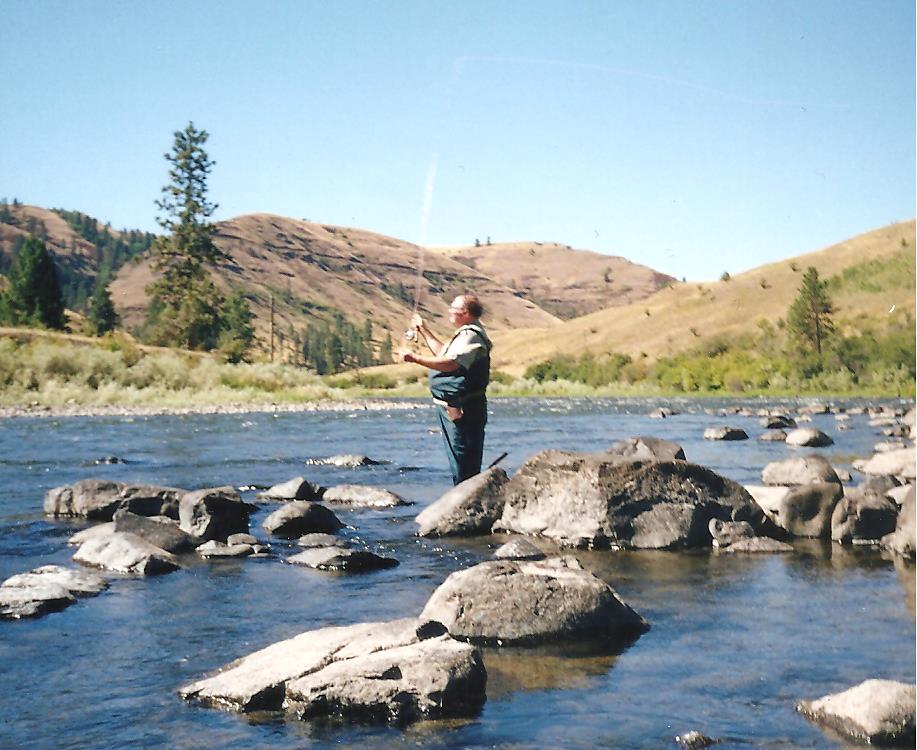
The Grande Ronde River snakes through a 40-mile route from Oregon’s eastern border all the way to the confluence of the Snake River. It is one of Oregon’s most popular steelhead streams, but during the summer months Spring Chinook, Rainbow trout, smallmouth bass and catfish are readily available. 

The high desert terrain of the region offers spectacular scenery, clean, fresh air, an abundance of wildlife such as Big Horn sheep, elk, deer, wild turkeys and the steelhead of the Grande Ronde. This is what lured my friend Jim Colantino and I to spend several days at Troy, Oregon to fish this legendary river for Steelhead. However, we would encounter a few interferences that would change our course of action. 

First and foremost, this river is extremely popular in the fall, and as we drove down the road that paralleled the river all of the campsites were occupied. This unfortunate situation forced us to stay at the old rustic Troy Hotel. Also, the river’s popularity was clearly evident in the car licenses of dozens of other states. Because of this dilemma, most of the good water was taken up by other anglers. This meant that we would have to fish behind other anglers, fish secondary water or fish for trout. We returned to the hotel and plotted our strategy for the next day. 

The next morning we found good looking trout water and managed to catch some nice ones using Muddler Minnows and caddis patterns. Things were looking up, but our trip suddenly came to an abrupt halt when Jim’s hip began to give him some problems. The rough, rocky terrain made it difficult for him to walk. Then, I slipped on a rock and cut my knee badly. It was an arduous endeavor for both of us as we hobbled back towards our car. Then, we encountered another problem. A large rattlesnake was guarding the trail that we were on, so we carefully navigated around the potential danger. Because of these unforeseen events, our trip was unanimously aborted, and we packed up and left with some reservations. 

In spite of this discouraging outcome, we agreed to come to the Grande Ronde once again because it has been said that fishing is not always about catching. It can be a refreshing change from city life and you will have opportunities to look around and enjoy the country’s surroundings and its wildlife.


Saturday, December 13, 2014

A Boy's First Trout

Ten year old boy squatting on the river bank wearing sunglasses and a fishing vest holding a 20 pound trout he had just landed.
David's First Trout
My son David was the last of my four sons to learn how to fly fish and experience success. He had learned how to tie flies and cast, but catching his first trout had eluded him until he was ten years old. Success finally came on a float trip down the Deschutes River but not without a few apprehensive moments.

As I helped my son rig up his outfit, I briefly explained how to mend the line and use the wet fly swing to present the fly down and across the current. I also told him to keep the rod at a low angle as the fly swings and not to jerk the rod if he got a take. At my suggestion, he tied on an old reliable orange-bodied Tied Down Caddis. Finally, I reminded him to be careful of the rattlesnakes when he was walking, and if he saw one to stop and shout for help. He nodded with assurance and headed up to a nice riffle.

From camp I watched him make his first few casts, and I felt that this might be the time David would catch his first trout. After half an hour nary a sound was heard, and I was wondering if he might need some help when a blood-chilling scream echoed in the air. I thought “snake” and rushed up stream for fear that he had been bitten, but it was a false alarm. David had finally hooked his first trout and it was a nice one. After several intense minutes he finally landed it. It was close to 20 inches.

I took a quick photo and after he released it I asked him how he enjoyed the action. All he could say was “excellent.” From then on I knew that he may have thought that he had hooked the fish, but in reality the fish had hooked him for life. 

Wednesday, December 10, 2014

Kubitz Special Steelhead Fly

steelhead fly with green and purple and tinsel body, krystal flash tali and wing, and purple front hackle
Kubitz Special Steelhead Fly
The Kubitz Special steelhead fly had an interesting development. When my son Jeff was 12 years old, he was helping me in my fly shop. Being a creative fly tier, he would at times make up some weird looking patterns. They went mostly unused, but I would keep them around my desk so he wouldn’t feel as though his efforts went for naught. One day he tied a fly that was somewhat uncustomary in that Krystal Flash was a predominant feature. Like the others, it was added to the collection. It remained there for several months, but every so often it would catch my eye and I’d pick it up to consider its possibilities.

This feeling gradually grew on me until my curiosity was overwhelming, and I decided to try it for winter steelhead. The next morning I drove to the Sandy River and began casting my 350-grain shooting head with a 10-pound, five-foot leader.  Four casts later I had hooked and landed a bright 20-pound fish. With this startling success, I began to use a sparse amount of Krystal Flash for some of my standard patterns.  From then on I paid more attention to Jeff’s creative fly innovations. The fly was named after the access road to the river.

Materials:
Hook:  36890 Nos. 4-6
Tail:  Black Krystal flash                                                                          
Body:  Rear 1/3 hot green chenille, front 2/3 purple wool
Rib:  Silver oval tinsel
Hackle:  Purple saddle
Wing:  Full black Krystal Flash tied in body length
Head:  3/0 black

Step 1
Attach a sparse amount of black Krystal Flash 
for the tail. Tie in the oval tinsel and the chenille. 

Step 2
Wrap the green chenille up 1/3 and attach he purple wool. 

Step 3
Wrap the wool up and follow with five to six turns of tinsel.  
Attach the purple hackle.
Step 4
Spin the hackle forward three to four times and wrap slightly back 
over it to form a 45-degree angle. Then, tie a full wing of Krystal 
Flash about the length of the body. Finish the head and cement. 

Please read our terms of use policy